Learn Belarusian (free language course video)
Warning: Undefined variable $post_id in /home/webpages/lima-city/booktips/wordpress_de-2022-03-17-33f52d/wp-content/themes/fast-press/single.php on line 26
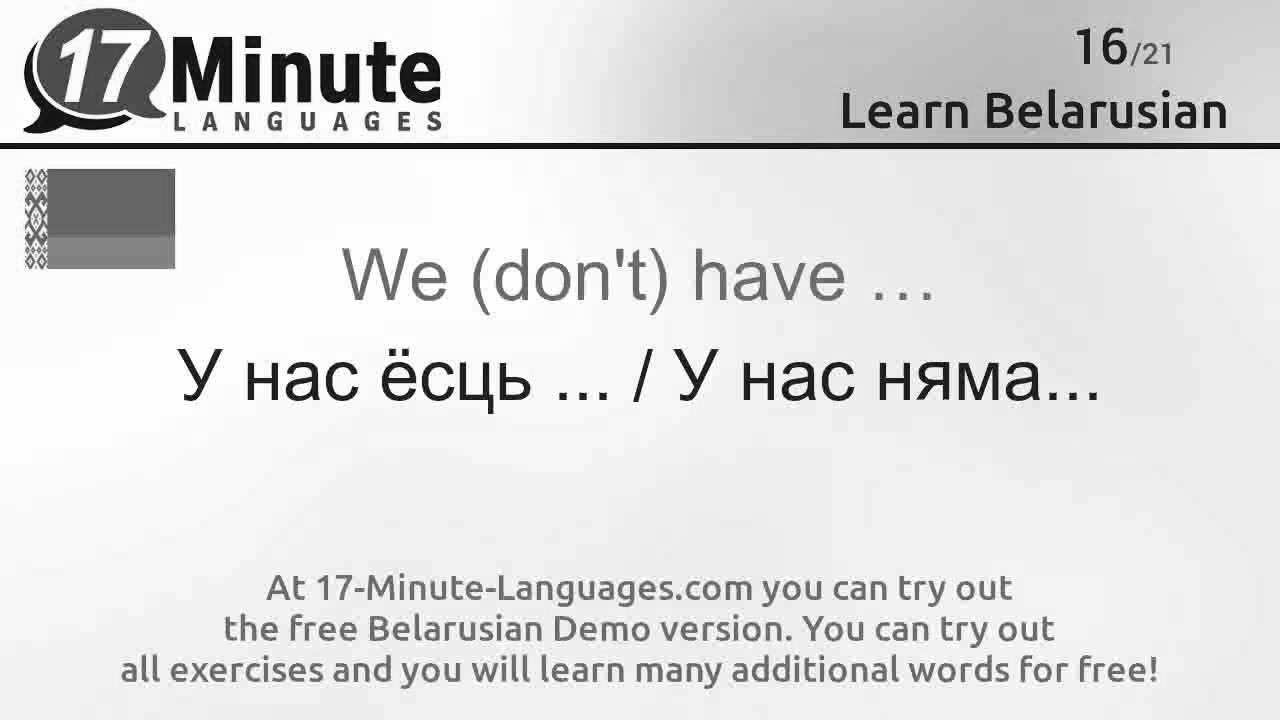
Study , Be taught Belarusian (free language course video) , , uVb574CVEQM , https://www.youtube.com/watch?v=uVb574CVEQM , https://i.ytimg.com/vi/uVb574CVEQM/hqdefault.jpg , 10460 , 5.00 , https://www.17-minute-languages.com/en/by/ On this video you'll study an important phrases in Belarusian. Watch this video... , 1465021276 , 2016-06-04 08:21:16 , 00:05:11 , UC6jZJ2MAfbqXjl0bWu2NsKw , 17-Minute-Languages Video , 192 , , [vid_tags] , https://www.youtubepp.com/watch?v=uVb574CVEQM , [ad_2] , [ad_1] , https://www.youtube.com/watch?v=uVb574CVEQM, #Learn #Belarusian #free #language #video [publish_date]
#Learn #Belarusian #free #language #video
https://www.17-minute-languages.com/en/by/ On this video you will learn an important words in Belarusian. Watch this video...
Quelle: [source_domain]
- Mehr zu learn Encyclopedism is the physical entity of acquiring new disposition, knowledge, behaviors, trade, values, attitudes, and preferences.[1] The cognition to learn is berserk by humanity, animals, and some equipment; there is also evidence for some rather learning in definite plants.[2] Some encyclopaedism is fast, induced by a unmated event (e.g. being burned by a hot stove), but much skill and noesis put in from recurrent experiences.[3] The changes spontaneous by learning often last a time period, and it is hard to identify knowledgeable fabric that seems to be "lost" from that which cannot be retrieved.[4] Human encyclopedism get going at birth (it might even start before[5] in terms of an embryo's need for both action with, and unsusceptibility inside its state of affairs within the womb.[6]) and continues until death as a consequence of current interactions betwixt populate and their environs. The quality and processes caught up in encyclopedism are affected in many constituted fields (including instructive psychological science, psychology, psychological science, cognitive sciences, and pedagogy), too as future comic of noesis (e.g. with a common interest in the topic of eruditeness from guard events such as incidents/accidents,[7] or in cooperative education health systems[8]). Research in such comic has led to the designation of different sorts of education. For example, encyclopedism may occur as a effect of dependency, or conditioning, conditioning or as a effect of more complicated activities such as play, seen only in comparatively searching animals.[9][10] Encyclopedism may occur consciously or without aware cognisance. Encyclopaedism that an dislike event can't be avoided or loose may result in a condition called well-educated helplessness.[11] There is bear witness for human activity encyclopedism prenatally, in which addiction has been ascertained as early as 32 weeks into construction, indicating that the essential unquiet system is sufficiently formed and fit for education and mental faculty to occur very early in development.[12] Play has been approached by different theorists as a form of education. Children try out with the world, learn the rules, and learn to act through and through play. Lev Vygotsky agrees that play is pivotal for children's maturation, since they make content of their environs through and through performing acquisition games. For Vygotsky, yet, play is the first form of encyclopedism word and human activity, and the stage where a child begins to read rules and symbols.[13] This has led to a view that education in organisms is e'er kindred to semiosis,[14] and often related with mimetic systems/activity.
It is important to note that Utopia is not a whitepaper, some abstract idea or statement of intent. This is a fully functional software product ready to be used.
Добрай раніцы! Націск падае на літару "а". р'Аніца🌝
1:30 так*
Яна які казаў так дзіўны😂😂
Прывiтанне 😏
Isn't it "мяне" with accent on the last syllable?
Памылак шмат: вось, напрыклад, "прывет" дакладней "вітаю"/"прывітанне''; "да" – "так"; "я жанат" – "я жанаты", бо няма кароткай формы прыметнікау у мужчынскім родзе, і гэтак далей